
Kirsty Gogan, Terra Praxis Founding Director and Co-CEO, participated in the closed-door session to advance practical pathways toward safe and commercially viable nuclear-powered shipping. The event, taking place in Athens, follows a recent announcement from the Government of Greece signaling that the time has come to take nuclear energy seriously, with specific reference to commercial ships powered by nuclear reactors. Greece, like many other countries, is actively considering advanced nuclear technology as part of its future energy structure and maritime transport.
The roundtable also provided an opportunity to share progress on the Atomic Technologies Licensed for Applications at Sea (ATLAS) initiative. Terra Praxis chaired the inaugural meeting of the IAEA's ATLAS initiative in 2024—attended by IAEA Director General Rafael Mariano Grossi—which aims to establish a regulatory framework for the safe and secure deployment of peaceful civil nuclear applications at sea.
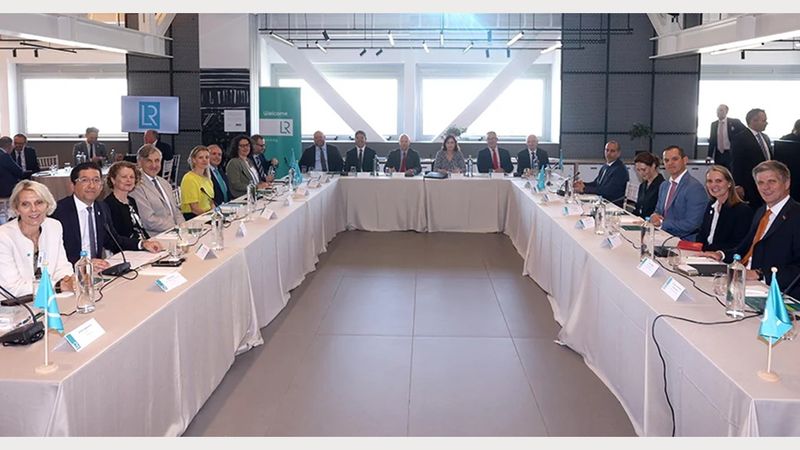
Lloyd’s Register's press release (below) covers the key proceedings and includes a link to brief interview with Karine Herviou, Deputy Director General of the IAEA, and Nick Brown, CEO of Lloyd's Register:
Chaired by Mark Tipping, LR’s Power to X Director, the discussion focused on key areas where progress will determine whether nuclear can move beyond concept stage. Participants examined how regulatory frameworks can evolve to support controlled demonstration without compromising safety, how commercial models might develop to manage the high upfront costs, and where nuclear may have advantages over other zero-carbon fuel options.
Contributors highlighted the absence of an established international framework tailored to civil nuclear applications at sea. At the same time, participants stressed that regulation must move in parallel with technology development, rather than waiting for mature designs to emerge.
The economic case for nuclear also came under scrutiny. Participants explored potential cost drivers, investment models and areas of disruption across ship design, operations and infrastructure. While recognizing the significant barriers to entry, the discussion acknowledged that early adopters could gain a competitive advantage as technologies mature.
Comparisons with other fuel pathways formed a central part of the debate. Delegates considered the relative efficiencies, system constraints and integration challenges of nuclear alongside other transitional alternative fuels.
The roundtable also provided an opportunity to outline progress on the Atomic Technologies Licensed for Applications at Sea (ATLAS) initiative. The project aims to establish a clear framework for the safe and secure deployment of civil nuclear technologies in maritime applications, addressing key regulatory, safety and assurance challenges.
Deputy Director General Karine Herviou said: “This is a very important conversation. One of the main issues is the need to have an international framework to provide regulatory predictability.
“The ATLAS initiative has as its objective the need to identify this international framework, and reach consensus needed to create harmonization of the requirements of different countries.”
Nick Brown, Lloyd’s Register CEO, said: “LR is delighted to hold this important conversation bringing together the highest level of international maritime influencers to the table... We brought together the nuclear industry, the maritime industry, and regulation. We heard of the very clear and compelling speed that the regulation needs to be here because we have small modular reactors starting to go critical within the next month... Today’s conversation was a very clear indication that the work of ATLAS, the work of the UK Maritime Nuclear Consortium, the work of NEMO, is going to be demanded by industry to ensure that there is a path to application and scale.”
Reflecting on the roundtable conversation, Mark Tipping, Power to X Director, Lloyd’s Register, said: “Today’s roundtable convened a unique blend of maritime nuclear, maritime, government and regulatory leaders...It presented an opportunity that participants were eager to engage in—understanding each other’s requirements but also projecting what each aspect of the value chain requires from each other to build a unified approach to delivering nuclear in maritime.”
Alongside the roundtable, LR will announce progress on a joint development project with Hyundai Heavy Industries, Korea Shipbuilding & Offshore Engineering (KSOE), Hyundai Glovis, G-Marine Service and the Korea Atomic Energy Research Institute (KAERI), focused on an advanced small modular reactor (SMR) installation on a pure car and truck carrier (PCTC).
The partners will mark a key milestone for the project with an Approval in Principle (AiP) ceremony at the LR stand during Posidoniaon Tuesday 2 June.